SRA eyeing role of solicitors amid Man City fallout
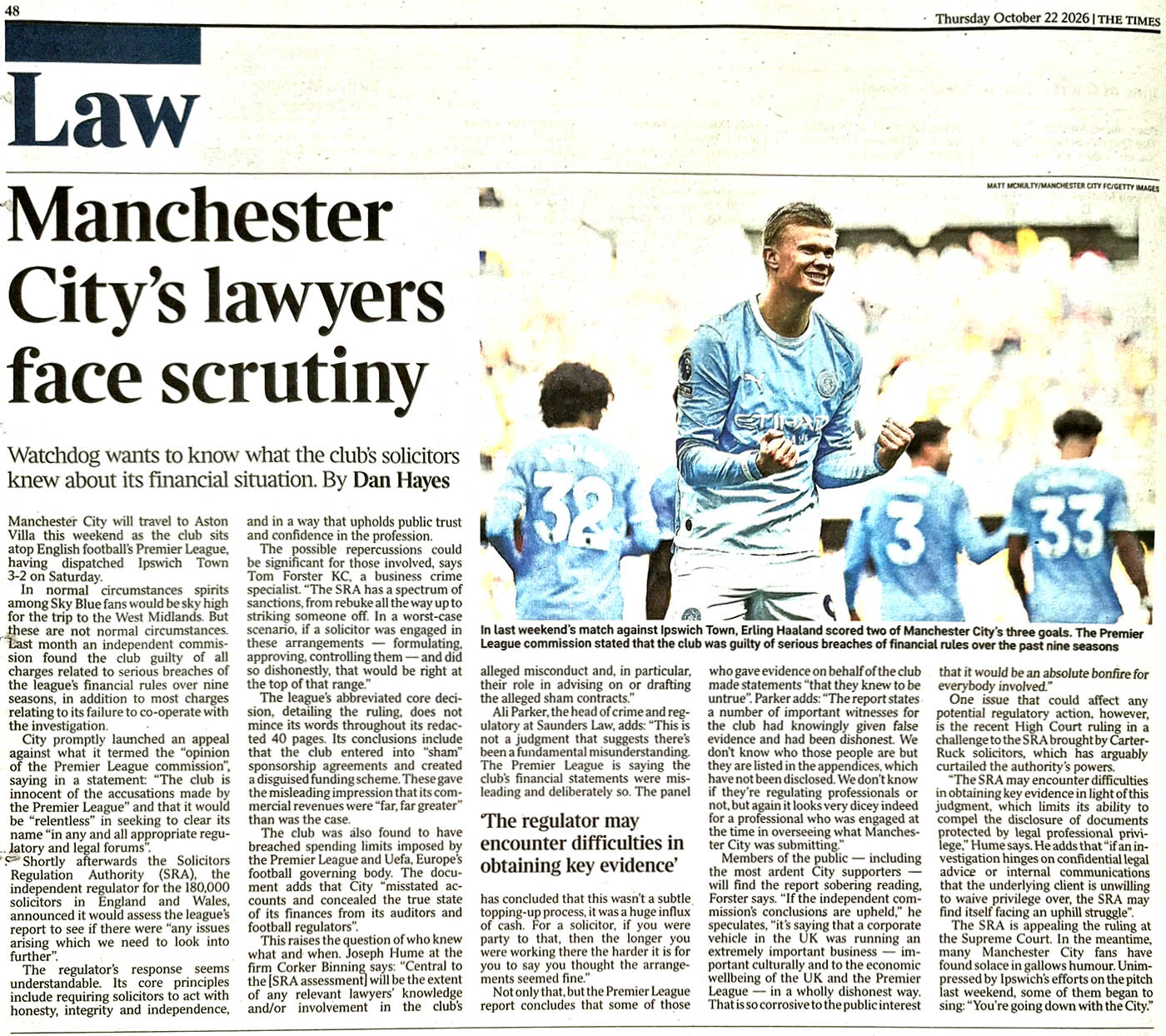
The Solicitors Regulation Authority will examine this week’s damning Premier League report on Manchester City and investigate any potential solicitor misconduct as more information is made public.
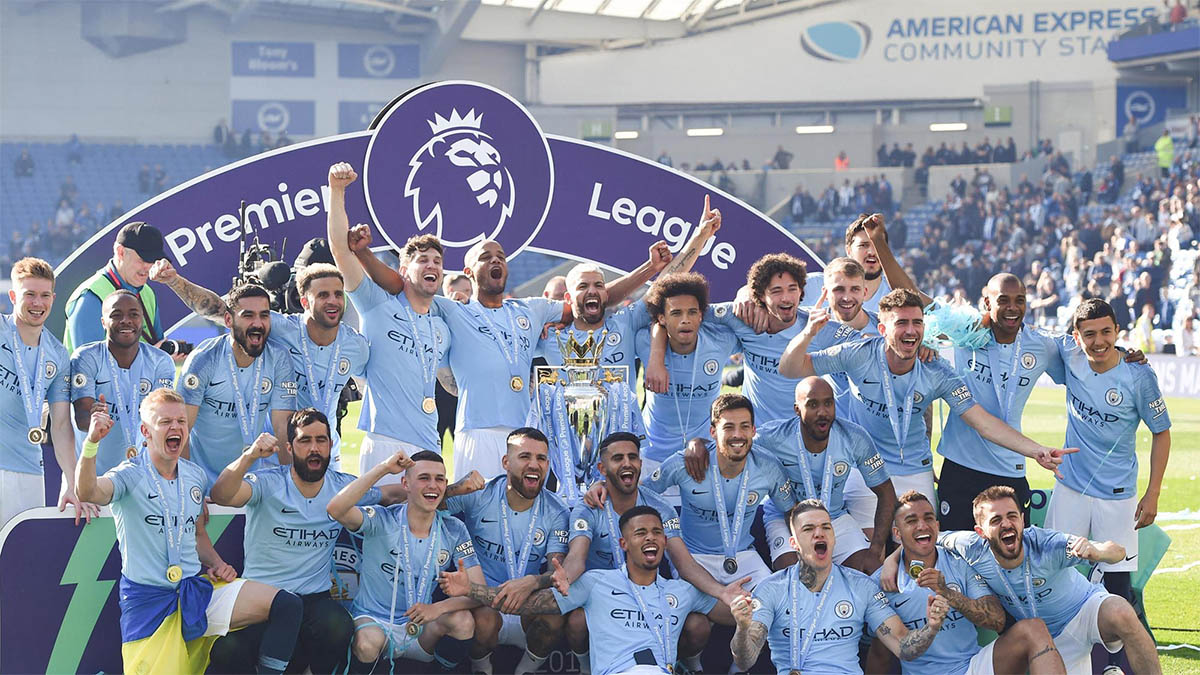
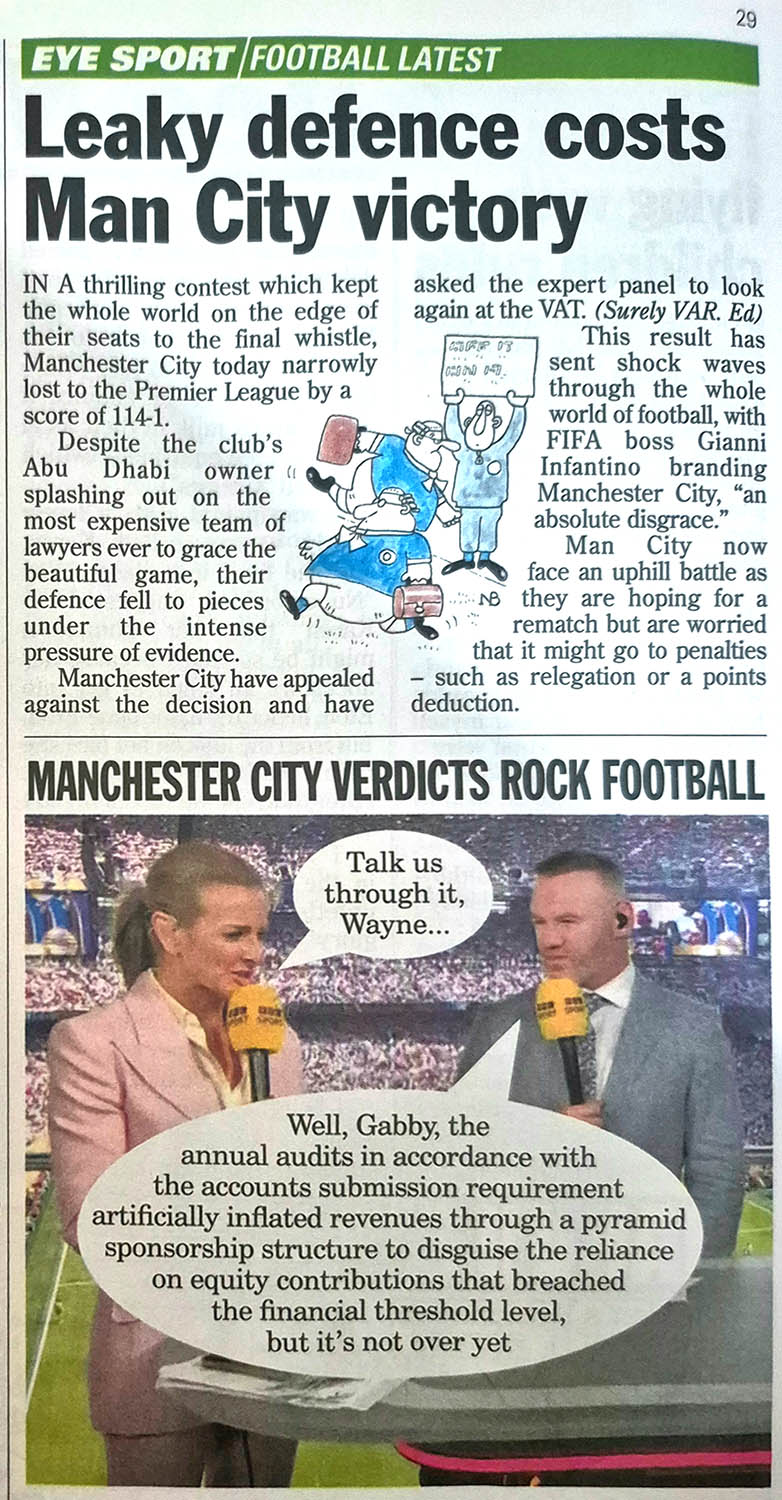
An independent commission found the football club guilty of all charges related to serious breaches of the league’s financial rules over a nine-season period, a decision that will have far-reaching consequences for sports governance. The commission found that City arranged ‘sham’ contracts with several commercial partners and sponsors which were part of a disguised funding scheme. The remainder was funded by Abu Dhabi United Group Investment & Development Ltd (ADUG), which owned the club.
Premier League rules limit how much money clubs can spend on their squads.
Manchester City’s top lawyer was, for a brief period, a director of one of the companies found to be ‘little more than a front’ for the football club’s owner to hide its true investment, it has emerged. The commission’s redacted ruling refers to ‘Project Longbow’, launched in the third quarter of 2012 to explore how the club might boost its revenues and reduce its operating losses. While many strands of Project Longbow were legitimate attempts to achieve those aims, the commission found that the so-called Fordham Arrangement was not.
In essence, this was a ‘closed-circle’ arrangement entered into by the club with a third party called Fordham, ‘which in reality was little more than a front for ADUG’. The owner’s funds were used to enable Fordham to acquire from the club ‘at a sizeable, artificially inflated price’ the club’s entitlement to benefit financially from its players’ image rights. The Fordham Arrangement was a device by which ADUG funds could be paid into the club ‘in a manner that concealed their true origin and which enabled the club to pretend that such funds represented operating income in its financial statements’.
The part of the ruling identifying who knew about the reality of the Fordham Arrangement is redacted, as is the list of individuals who approved it. These are both included in an appendix to the ruling that has yet to be published.
Fordham refers to a company now known as Fordham Sports Image Rights Ltd, which was called Manchester City Football Club (Image Rights) Ltd from October 2012 to July 2013. Companies House records show that Simon Cliff was appointed a director of the company in June 2012 and remained in that position until July 2013.
Cliff, admitted as a solicitor in 2002, was general counsel for Manchester City Football Club from 2009 to January 2013 and is now general counsel for the City Football Group, which is the club’s parent company and owns a stake in other clubs across the world. There is no suggestion in the commission ruling that Cliff is one of the names redacted or that he had any knowledge of the Premier League rule breaches.
Cliff has previously been named in media coverage of investigations into Manchester City. German news magazine Der Spiegel reported in 2018 that Cliff had coined the term ‘Project Longbow’.
The Solicitors Regulation Authority is understood to be monitoring the situation and will examine the unredacted ruling when it is published. A spokesperson said: ‘We will be considering the content of the Premier League’s report to see if there are any issues arising which we need to look into further. If, and where, we identify any suggestions of potential misconduct by solicitors or law firms, we will consider them carefully before deciding on potential next steps.’
It has also been suggested that City could be forced to pay the Premier League £50m in legal costs.
In a statement, Manchester City said: ‘The club is innocent of the accusations made by the Premier League and a comprehensive body of irrefutable evidence exists in support of all of its positions, relating to this case. The club will therefore be relentless, and where necessary proactive, in any and all appropriate regulatory and legal forums. The Premier League process remains ongoing, with significant elements uncompleted. Manchester City FC will now pursue the appeal avenues open to it, on the basis that the opinion contains clear material errors of law, principle and fact, and is unsafe.
‘The club has diligently respected due process for eight years on the basis that the Premier League board and executive would behave as an independent, impartial and fair-minded regulator, free from partisan influence.
‘The club is obviously restricted in what it can say further until all future proceedings are complete.’
Law Society Gazette
By John Hyde
2 October 2026
Original article HERE
The Premier League v Manchester City: Penalty shoot-out
The Premier League has now published a ’core decision’ (in redacted form) in its case against Manchester City. The result is no longer a matter of speculation: an independent Commission has found all charges relating to breaches of the League’s financial rules proved, spanning a nine-season period, together with most of the alleged failures to co-operate with the League’s investigation. The Premier League is not a public regulator in the orthodox sense; it is a private company operating through contractual rules agreed by its clubs. Publication of the core decision, even in redacted form and with detailed reasons to follow, strengthens the legitimacy of a process conducted behind closed doors and provides the necessary foundation for public scrutiny of any sanction.
Max Baines
The findings are stark and damning. Between 2009 and 2018, the Commission concluded that City used a ’disguised funding scheme’ under which substantial sums paid by its owner, Abu Dhabi United Group Investment & Development Ltd (ADUG), were presented as sponsorship income from commercial partners. The sponsors were liable only for a base sum, ADUG supplied the balance. These “sham” contracts underpinned a scheme which was designed, according to the Commission, to mislead auditors and regulators as to the true state of the club’s finances. The effect was to artificially inflate the club’s revenue by more than £830 million across the period and thereby reduce its apparent costs in order to satisfy both UEFA’s break-even requirements and the Premier League’s Profitability and Sustainability Rules, which in reality it had breached by a “very substantial amount”.
Subject to a successful appeal, the proceedings now move to penalty and the stakes for both sides could scarcely be higher. Any suggestion of a negotiated compromise on sanction is wide of the mark – an “Agreed Sanction” is available in some cases but not here. The disciplinary provisions are found at section W of the Premier League Rules and the Commission’s powers on sanction at Rule W.64. A vast financial penalty seems inevitable (and there is no limit on its size) but the critical question for the Commission will be how it approaches any sporting sanction. The Commission enjoys a wide discretion and may impose any penalty as it shall think is fit. However, under Rule W.64.4 (when dealing with a club) the Commission has an explicit power to suspend, deduct points or recommend expulsion from the League.
The Rules on penalty are not supplemented by any guidelines and comparisons with sanctions handed down in previous cases of financial misconduct are of limited application where the Premier League has never before grappled with sustained offending on such a scale. The breaches will surely be further aggravated by the Commission’s finding that “the Club clearly intended to circumvent the PL Rules” – this case was about concealment and dishonesty not mismanagement. As the Chief Executive of the Premier League commented after the publication of the Core Decision: “the club systematically broke Premier League rules for nearly a decade”. The breaches of the club’s duties of co-operation and good faith in the process itself will surely further elevate any sanction.
A points deduction at a level which leads to relegation, or expulsion, must therefore be regarded as realistic possibilities. The latter nuclear option has never been invoked but the unprecedented nature of the case means that the club must expect the Commission to consider it. The immediate question is when any sanction can take effect. The Premier League has expressed its intention “that the full process (including any appeals and publication of relevant decisions) is concluded as soon as possible”. After an eight-year investigation expedition would be widely welcomed but the timetable is not within the League’s control. Manchester City has confirmed that it will appeal the Commission’s decision ahead of the 2 October deadline and, under Rule W.86, an appeal ordinarily has a further 12 weeks in which to conclude, with another 30 days available to provide a decision.
An Appeal Board may vary or disapply those standard directions but, even if that period is abbreviated, further delay extending into the resumption of the Premier League competition following the international break appears inevitable. Issues of fairness will flow for a club that plays and loses to Manchester City in that period where a rival club does not. Similarly, if expulsion is to be the penalty and takes effect mid-way through the season, what happens to the points won or lost in fixtures against Manchester City to date? The timing of any final decision and ensuing sanction will be contentious whenever it falls.
This case, however, is about far more than Manchester City’s trophy cabinet in this or any previous season and the sporting consequences for its rivals. It is a test of the Premier League’s ability to regulate the clubs that generate its greatest wealth and global status. The new Independent Football Regulator will alter the wider governance landscape but it will not remove the League’s responsibility for enforcing the rules of its own competition. If City ultimately prevail in an appeal, the League’s authority may be gravely weakened. If the charges are upheld and meaningful sanctions follow, English football will have crossed into a new era: one in which ownership, governance and financial transparency can no longer be treated as matters of private club management.
Max Baines is a barrister at Red Lion Chambers specialising in financial crime and sports law.
Law Society Gazette
By Max Baines
2 October 2026
Original article HERE